
Criminal Court Cases in Salt Lake County
Salt Lake County criminal court cases do not all go to one clerk. Utah District Court handles felonies and class A misdemeanors. The Third Judicial District serves the county, with district locations at the Scott M. Matheson Courthouse in Salt Lake City and the West Jordan courthouse. Class B and C misdemeanors, infractions, local ordinance charges, and many traffic cases go to the territorial justice court. That may be Salt Lake County Justice Court or a city court in Salt Lake City, West Valley City, West Jordan, or another municipality.
The clerk for the court where a case was filed keeps the official court file. The case may contain the prosecutor's filed information, motions, hearing minutes, plea, judgment, and sentence. A sheriff booking entry does not establish which court received a charge. Start with the alleged offense level, city or agency, and filing location. Then confirm the court on the docket rather than assuming every Salt Lake County criminal case is stored downtown. Releasable prosecution material follows the District Attorney's separate GRAMA request channel.
Salt Lake County Criminal Court Locations
The Matheson criminal desk is the practical clerk fallback for many Third District cases filed in Salt Lake City. The official Salt Lake County court directory helps identify the right district or justice court. A southern-county district file may instead be held at West Jordan. Lower-level cases stay with the county or municipal justice clerk that had jurisdiction.
Matheson Third District Court
450 South State Street
Salt Lake City, UT 84114-1860
Criminal desk: 801-238-7321
West Jordan District Court
8080 South Redwood Road
West Jordan, UT 84088
801-233-9700
Salt Lake County Justice Court
2001 South State Street, Suite S4-300
Salt Lake City, UT 84190
385-468-8200
Each office holds a different part of the county court system. Contacting the correct clerk prevents a false no-record result caused by searching the wrong jurisdiction.
Salt Lake County Case Record Searches
Xchange Case Search gathers public CORIS records from Utah District and Justice Courts. It is the broad remote route, though it requires an account and charges under Utah Courts' current pricing. Public terminals at most district courthouses and the State Law Library provide a free search alternative. Parties can use MyCase for their own eligible matters.
- Select District Court, Justice Court, or both. Use both if the offense level or filing court is uncertain.
- Choose statewide, Salt Lake County, or a specific court scope. A county-wide search helps when the correct justice court is unclear.
- Search by case number when known. Otherwise enter the party name, then narrow by date, court, filing range, or case type.
- Open the case number to read the extended history. Check charges, dated events, minutes, orders, accounting, disposition, and sentence.
- Ask the official clerk for a certified copy or an older file. A purchased Xchange image is not automatically certified.
| Field or control | Type | Required | Use |
|---|---|---|---|
| Jurisdiction | Selection | Unspecified | District Court, Justice Court, or both |
| Search scope | Selection | Unspecified | Statewide, county, or particular court |
| Party name | Text | Mode dependent | Exact spelling first; add first or middle name to narrow |
| Case number | Text | Alternative | Most precise route to one Salt Lake County case |
| Date range | Date range | No | Narrows filing or disposition dates |
| Case type | Code selection | No | Includes FS, MD, MO, and IF among other types |
Reading Salt Lake County Xchange Results
The official Xchange help page distinguishes a summary from the extended case history. Summary results can show parties, charges, events, available document links, and accounting. Selecting the case number opens more detailed minute entries. A purchase link appears only when a public electronic document is available. Utah Courts says district documents filed on or after July 1, 2010 are being made available progressively, so an absent image does not mean the clerk lacks the document.
The Utah Courts Xchange help screen illustrates how searches and histories are organized.
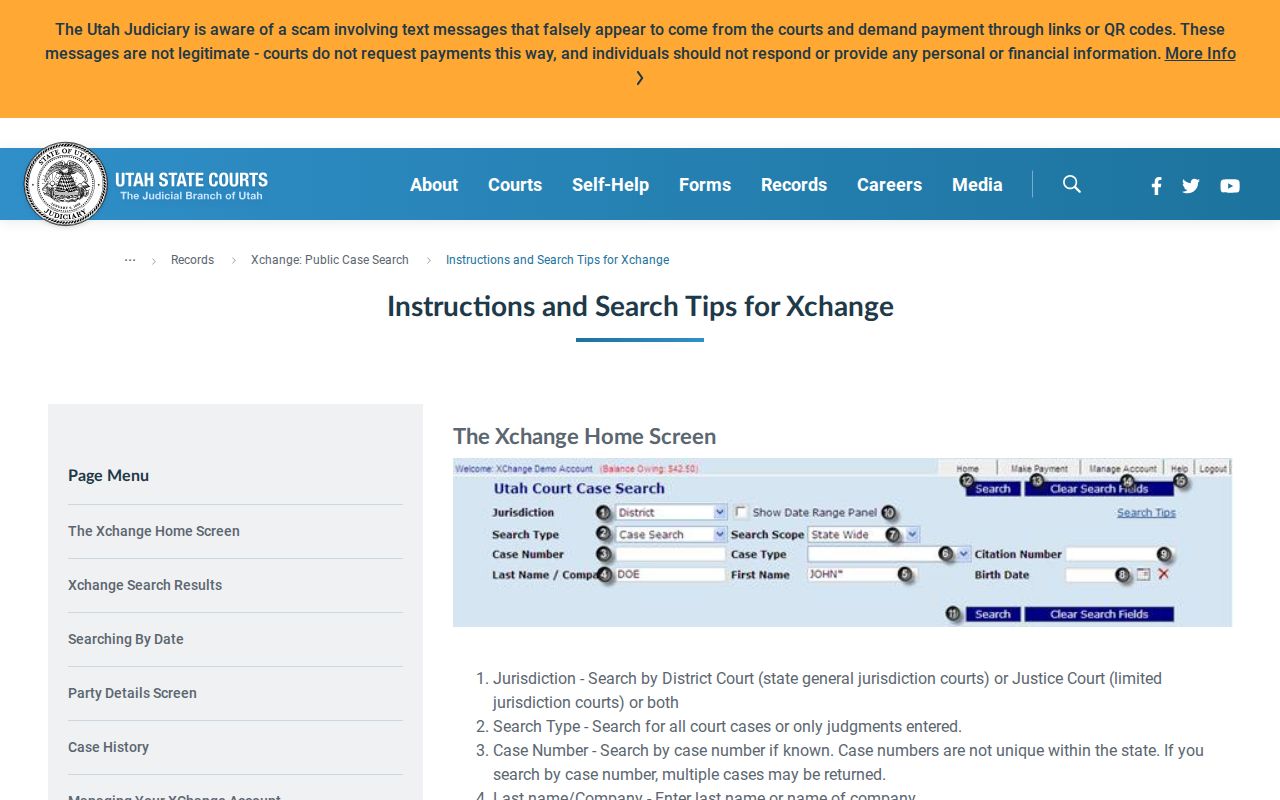
That layout helps separate a filed charge from a later plea, dismissal, judgment, or sentence. Read the dated history rather than relying on the first charge line alone.
Note: A name match is a lead, not identity proof; compare the court, case number, dates, and permitted identifiers before drawing conclusions.
What a Criminal Case File Contains
A Salt Lake County criminal case file tracks the court proceeding after charges are filed. It adds detail that a BCI history or jail booking may omit, including the assigned judge, counsel, motions, hearings, and case-specific orders. Online visibility varies by document, date, court, and access classification.
| Case Number and Court | Identifies the filing year, case type, court, and official clerk. |
|---|---|
| Charging Document | States the prosecutor-approved counts, which may differ from arrest or booking charges. |
| Docket Entries | Lists dated filings, hearings, minutes, motions, orders, and case activity. |
| Judge and Attorneys | Shows judicial assignment and counsel of record where public. |
| Disposition and Judgment | Records how each filed count ended, such as plea, dismissal, acquittal, or judgment. |
| Sentence and Accounting | May show sentence terms, probation action, fines, payments, and financial balances. |
When proof of outcome matters for personal record correction, obtain the clerk's certified disposition. Xchange is a useful index and history, but the clerk remains the record keeper.
Free Salt Lake County Case Search
Remote Xchange access has subscription and per-use charges. Salt Lake County residents can instead use a free public Xchange terminal at most district courthouses or at the Utah State Law Library inside Matheson. This route is useful for an occasional case lookup or when a remote account is not worthwhile. Printed copies and certified records may still carry clerk charges.
Bring the correct spelling, an approximate filing year, and the case number if available. The State Law Library can help with public legal research, but it does not decide access disputes or certify records. Ask the relevant clerk if a result points to a West Jordan or justice-court file. The free terminal changes the search cost, not the court that owns the case.
Criminal Case Stages in Salt Lake County
A Salt Lake County criminal case begins on the public court track when a prosecutor files charges. The arraignment records the initial court appearance and plea process. Pretrial entries may cover scheduling, discovery disputes, motions, negotiations, or warrant activity. A plea or trial resolves the fact-finding stage, while disposition identifies the outcome of each count. Sentencing follows a conviction or qualifying plea. Appeals, probation actions, payment entries, and later expungement orders can add more docket events.
Case flow: Charges Filed › Arraignment › Pretrial › Plea or Trial › Disposition › Sentencing
Timing differs by case and court, so a recent arrest may have no filed case yet. Conversely, the court history can remain after custody ends. For the initial booking rather than the filed charge, use the county Arrest Search routes.
Salt Lake County Criminal Case Codes
Xchange uses short case-type codes that can help narrow Salt Lake County court records. They describe the court case category, not the final outcome. The charging document and cited statute control the true offense level.
- FS State Felony
- A state felony case filed in District Court.
- MD Misdemeanor DUI
- A misdemeanor driving-under-the-influence case category.
- MO Other Misdemeanor
- A misdemeanor category outside the MD code.
- IF Infraction
- A non-jail offense category generally heard in Justice Court.
- Disposition
- The result of a filed count, not merely the event listed at arrest.
Read each code with the court location and case history. A justice-court code may also explain why an older matter is absent: local courts joined CORIS on different dates and chose whether to convert earlier files.
Older Salt Lake County Case Records
Most Utah district courts were using CORIS by the end of 1998, but justice courts adopted the system at different times. Some did not convert old records. If an expected Salt Lake County case is missing, identify the city or county justice court that had jurisdiction and ask its clerk to search older or offline material. Do not treat a blank Xchange result as proof that no historic file exists.
The official Salt Lake County Justice Court page is one local clerk route and is also the source shown below.
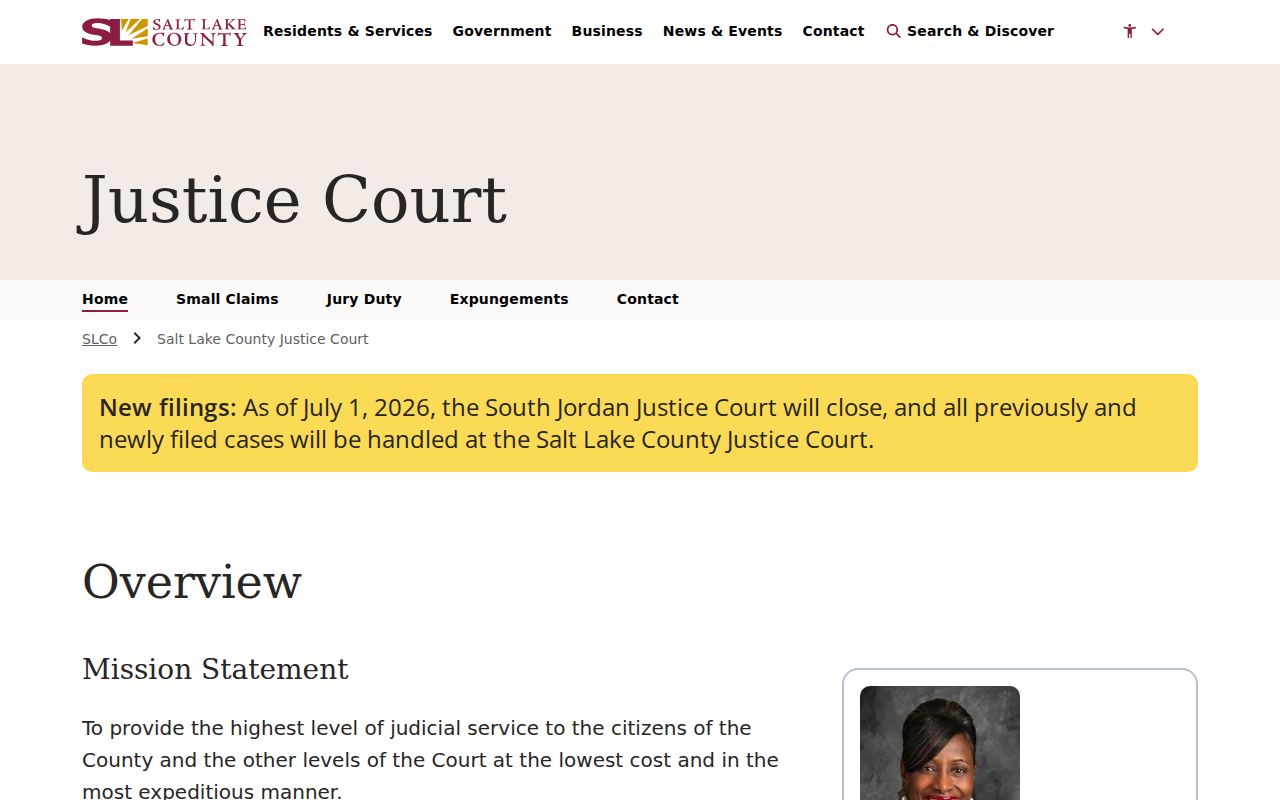
The county court handles only its territorial share. Municipal justice courts retain their own lower-level files, while Third District clerks hold felony and class A matters.
Access Rules for Case Records
Utah court records follow judiciary access rules as well as laws that protect specific information. The Xchange FAQ confirms that the service excludes expunged and sealed cases, juvenile delinquency and welfare matters, adoptions, civil commitments, and specified nonpublic case types. Public copies can also omit private identifiers, protected victim or witness details, medical information, and material sealed by court order. A document may exist in the official file without being available as an online image.
For a record that looks wrong, contact the District or Justice Court clerk that maintains it. Correcting a court docket is separate from challenging the Utah Department of Public Safety, Bureau of Criminal Identification history. If BCI lacks a disposition, the subject can use BCI's official challenge process with supporting court documents. An expungement order changes government access, but the agencies must receive and process the order. Federal criminal cases follow the U.S. District Court for the District of Utah and its PACER docket system, not Utah Xchange.