
Salt Lake County Sex Offender Checks
The official starting point is the Utah Department of Corrections registry page, which routes the public to the Utah Sex, Kidnap, and Child Abuse Offender Registry at sor.utah.gov. Search by a known name when identity is the main question. Use place-based tools when the concern is a Salt Lake County address, city, or neighborhood. A name match alone is not enough. Compare aliases, physical description, qualifying offense, registration status, and the date of the last update.
Salt Lake County police agencies and the Sheriff's Office perform local registration functions for people who are not registering through Adult Probation and Parole. Depending on jurisdiction, official starting points include the Salt Lake County Sheriff's Office, Salt Lake City Police, West Valley City Police, or West Jordan Police. The state portal remains the public layer. Call the UDC registry contact at 801-495-7700 if a profile seems wrong or a person may not be complying. Report an immediate threat to 911.
Metro Jail answers county custody questions, and the Matheson Courthouse criminal clerk maintains district case files. Neither is the source of a Salt Lake County registry profile. Registry records describe a current legal duty, not every offense or every person with a criminal case.
Search flow: Utah registry › Salt Lake County profile › local law-enforcement verification › NSOPW cross-state check.
Salt Lake County Registry Law Changed
Utah reorganized its registry law on May 6, 2026. The current framework is Utah Code Title 53, Chapter 29. Older agency pages and summaries may still point to former Title 77, Chapter 41. That old citation does not prove a Salt Lake County profile is stale, but it does mean the legal explanation should be checked against the current chapter before relying on it.
The title change matters because the current law defines who registers, which details an agency collects, how long duties last, when information changes must be reported, and which court-removal routes may apply. The current statute controls over a simplified chart or an old label. Offense, conviction jurisdiction, dates, supervision, and later orders can all affect the result. For a question about one person's legal duty, use the profile as a lead and the responsible agency or court as the official source.
Utah Sex, Kidnap, and Child Abuse Offender Registry Searches
The state interface supports public name and geographic searching, although its live controls were not stable enough for the research capture to document every radius choice. Do not assume a radius value or filter that is not shown on the live form. The safest Salt Lake County search method starts broad, then narrows only with details already known from a reliable source.
- Open the official UDC registry route and read its conditions of use.
- Search by the best known name or use the available Salt Lake County geographic controls.
- Compare the result with aliases, physical details, address information, offense data, and status.
- Check the update or verification date, then contact UDC or the registering local agency when a material detail looks wrong.
Spelling, aliases, moves, and agency update timing can affect results. A blank result does not prove that no duty exists, and a listed address should not be treated as permission to approach a home or person.
Salt Lake County Registry and National Searches
The National Sex Offender Public Website is the official federal layer for a person who may live, work, study, or travel beyond Utah. It searches participating state, territorial, and tribal registries. The following controls were documented on NSOPW. They should not be projected onto Utah's separate interface.
| Search field | Type | Use | Notes |
|---|---|---|---|
| First and last name | Text | Conditional | Use both for the name route. |
| ZIP Code | Text | Alternative | Accepts up to five ZIP codes separated by spaces. |
| County or City/Town | Text or selection | Optional | Narrows a place search. |
| State/Territory | Dropdown | Optional | Choose Utah for a state-focused pass. |
| Indian Country | Dropdown | Optional | Covers participating tribal registries. |
| Address and Distance | Text and dropdown | Radius mode | Read current distance choices on the live form. |
The manifest's successful NSOPW source capture shows the national search entry point used for this cross-state check.
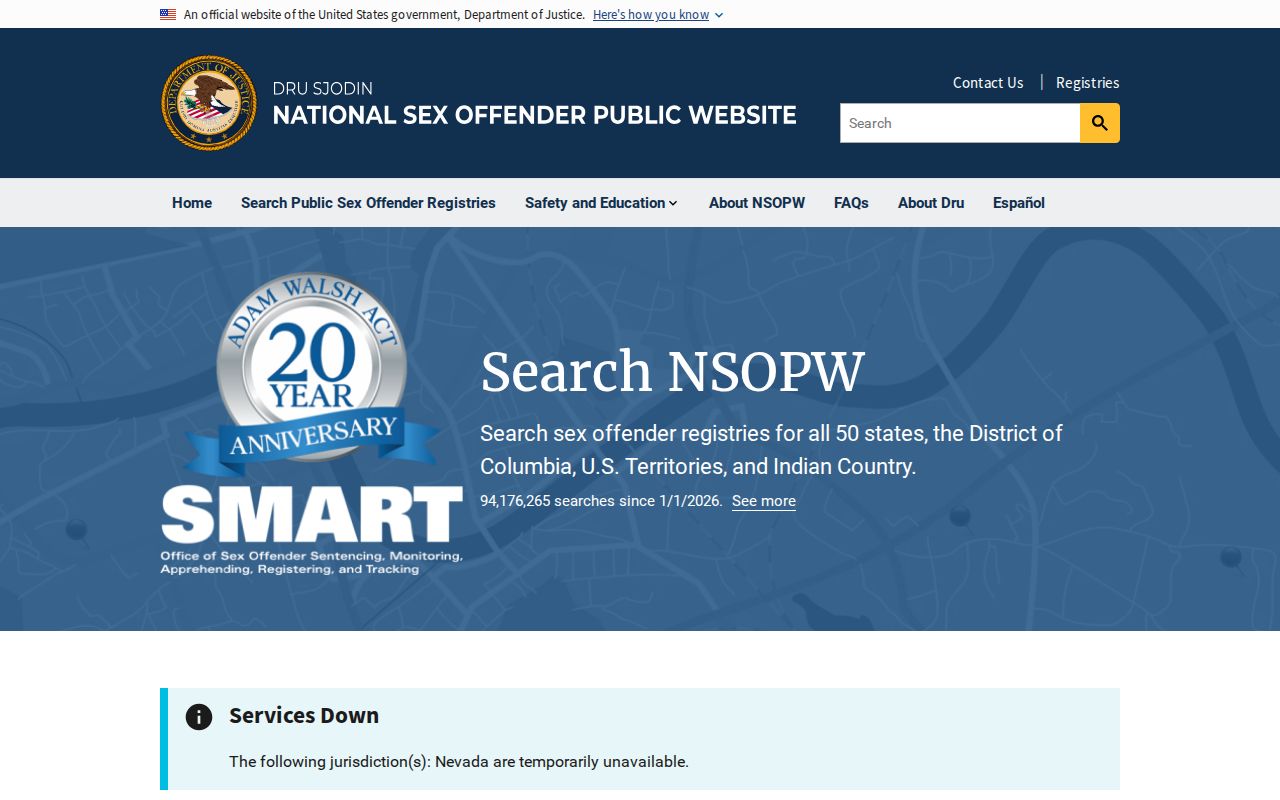
This national layer is most useful as a second pass, while Utah remains the primary source for the meaning and status of a Salt Lake County registration.
Registry Profiles: What They Show
Utah Code Section 53-29-304 requires the agency to collect a broad set of registration details. The public profile is a narrower publication. A Salt Lake County profile should be read for what it actually displays rather than treated as a copy of the full agency file. Victim identity and location, Social Security numbers, passwords, fingerprints, DNA, and sensitive identity documents are not ordinary public-profile fields.
| Name and Aliases | Displayed identity names used to distinguish a person from a similar name. |
|---|---|
| Photo and Description | Current photo plus available age or birth detail, height, weight, hair, eyes, and sex. |
| Address Information | The public level of residence detail supplied under Utah rules and the current record. |
| Offense Details | Qualifying offense, statute, conviction jurisdiction, and date when displayed. |
| Other Identifiers | Vehicle details and scars, marks, or tattoos where the public profile includes them. |
| Status and Verification | Registration or compliance status and the most recent verification information shown. |
Absence of a collected field from the public view does not mean the agency lacks it. It may be private, withheld for safety, or simply outside the public display.
Salt Lake County Registry Profile Boundaries
Utah collects names, aliases, residences, birth and physical details, photographs, fingerprints, qualifying vehicle data, telephone numbers, online identifiers, passport or immigration documents, licenses, education status, and certain employer or volunteer-place information. That statutory inventory helps agencies verify identity and compliance. It does not promise that each item will appear to a Salt Lake County neighbor who opens the public profile.
This boundary prevents two common errors. First, a hidden field should not be guessed from other data. Second, an empty public field should not be read as proof that the person has no such information on file. Use displayed profile facts for awareness. Send a suspected error to the registering agency or UDC, and give the profile name, page, and disputed field without posting private information elsewhere.
The Utah BCI crime-statistics index supplied another successful assigned source image for context.
Aggregate crime reports and individual registry profiles answer different questions, so statewide incident totals should never be used to infer facts about one registrant.
Registration Levels and Duties in Utah
Utah does not use public Tier I, Tier II, and Tier III labels as its operative duration table. Section 53-29-203 instead lists convictions and legal statuses tied to ten-year or lifetime registration. The exact offense list, dates, tolling rules, and later court action control. Translating a Utah record into a generic tier can create a false duration.
| Utah category | Duration | How to read it |
|---|---|---|
| Enumerated ten-year list | Ten years under statutory calculation and tolling rules | Check the exact Section 53-29-203 entry. Do not rename it Tier I. |
| Enumerated lifetime list | Life | The statutory list controls. Do not infer duration from an offense label alone. |
| Petition or removal route | Case specific | Sections 53-29-204 through 206 require route-specific eligibility and findings. |
Registration commonly occurs in the birth month and again six months later. Changes involving residence, work, vehicles, or education generally must be reported within three business days. A person arriving from another state generally registers within ten days. These duties are separate from how often a member of the public runs a Salt Lake County lookup.
Salt Lake County Registry Duration Mistakes
A ten-year label does not always mean ten calendar years from the conviction date. The statute's calculation and tolling rules matter. Supervision, custody, out-of-state history, later orders, and the precise qualifying status can affect the legal end point. Likewise, an expungement may restrict a criminal record without ending a registry duty. Registry removal follows its own statutory path.
For Salt Lake County, begin with the current public status, then read the exact Utah statute named on the profile or in the case. If the expected end date has passed but the entry remains, the correct response is an agency or court inquiry, not a claim that the listing is unlawful. The person subject to registration may need case-specific advice. A neighbor should report a suspected data problem through UDC or local law enforcement and avoid public speculation.
Salt Lake County Registry Address Rules
Utah's limits are offense and condition specific. Section 53-29-306 does not support a single blanket statewide residence radius that applies to every registered person. A court order, probation or parole condition, offense-specific rule, or local circumstance may matter. Do not draw a boundary on a Salt Lake County map from an unsourced distance found in an old summary.
Map and radius results also depend on data quality. NSOPW warns that coordinate searches work only when the participating jurisdiction supplies usable coordinates. No result near an address can reflect data sharing or geocoding limits rather than the absence of all registrants. Repeat the search by name, ZIP, county, and state when the safety question warrants it. Then check Utah's source profile for current details.
Using Registry Information Lawfully
Registry access supports awareness and practical safety planning. It does not authorize a confrontation, threat, trespass, intimidation, or unlawful discrimination. Do not contact a registrant's family, neighbors, or workplace to spread an allegation. Report suspected noncompliance to the responsible Salt Lake County police agency, the Sheriff's Office, or UDC. Use 911 only for an emergency.
Statutory misuse alert: Utah Code Title 53, Chapter 29 governs registry access and duties. It gives no permission to harass, threaten, intimidate, trespass, or use registry data to commit a crime. Misuse that constitutes a crime remains subject to criminal law.
Community notification is a source of safety information, not a verdict about current conduct. Verify each Salt Lake County record with the office that maintains it. Keep profile dates and source limits in view, and let law enforcement handle compliance checks.