
Salt Lake County Criminal History Checks
No single public database contains every Salt Lake County criminal record. Start with Utah Courts Xchange for filed District and Justice Court cases. Use the sheriff's prisoner information for current county custody, the police agency for its incident report, and the Utah Department of Public Safety, Bureau of Criminal Identification for a fingerprint-based review of your own Utah history. UDC Offender Search covers state imprisonment and adult probation or parole, not people awaiting trial in the county jail.
Gather a full name, spelling variants, an approximate year, and a case, incident, or booking number if one is known. A name match alone does not prove identity. Court level matters too. Third District Court hears felony and class A misdemeanor cases, while county and municipal justice courts hear class B and C misdemeanors, infractions, local ordinances, and many traffic matters.
- Define the record sought: a court case, current custody, police report, personal BCI history, or state supervision.
- Search the matching official system and include both District and Justice Court scope when the court is unknown.
- Compare identifiers, dates, court location, and case numbers before treating a result as the right person.
- Open the underlying docket or ask the creating agency for the report rather than relying on a result line.
- Request a certified court copy or BCI Right of Access record when an official document is required.
Salt Lake County Xchange Case Search
Xchange gathers Utah District and Justice Court data from CORIS. Information can appear after a local clerk enters it, but older justice court cases may be missing because courts joined CORIS at different times and made different conversion choices. Remote users register and pay under the service rules. A courthouse terminal is a free fallback, MyCase lets a party see eligible cases of their own, and the clerk can search older or offline material.
| Search control | Use in Salt Lake County | Key limit |
|---|---|---|
| Jurisdiction | Select District Court, Justice Court, or both | One level may miss the case |
| Name | Try exact and former spellings | A name is not identity proof |
| Scope | County, court location, or statewide | A case may be filed outside the county |
| Case number | Use for the most precise match | Enter the official format |
| Date and case type | Narrow common names and criminal categories | Older coverage varies |
The official Xchange overview shows how court access works statewide.
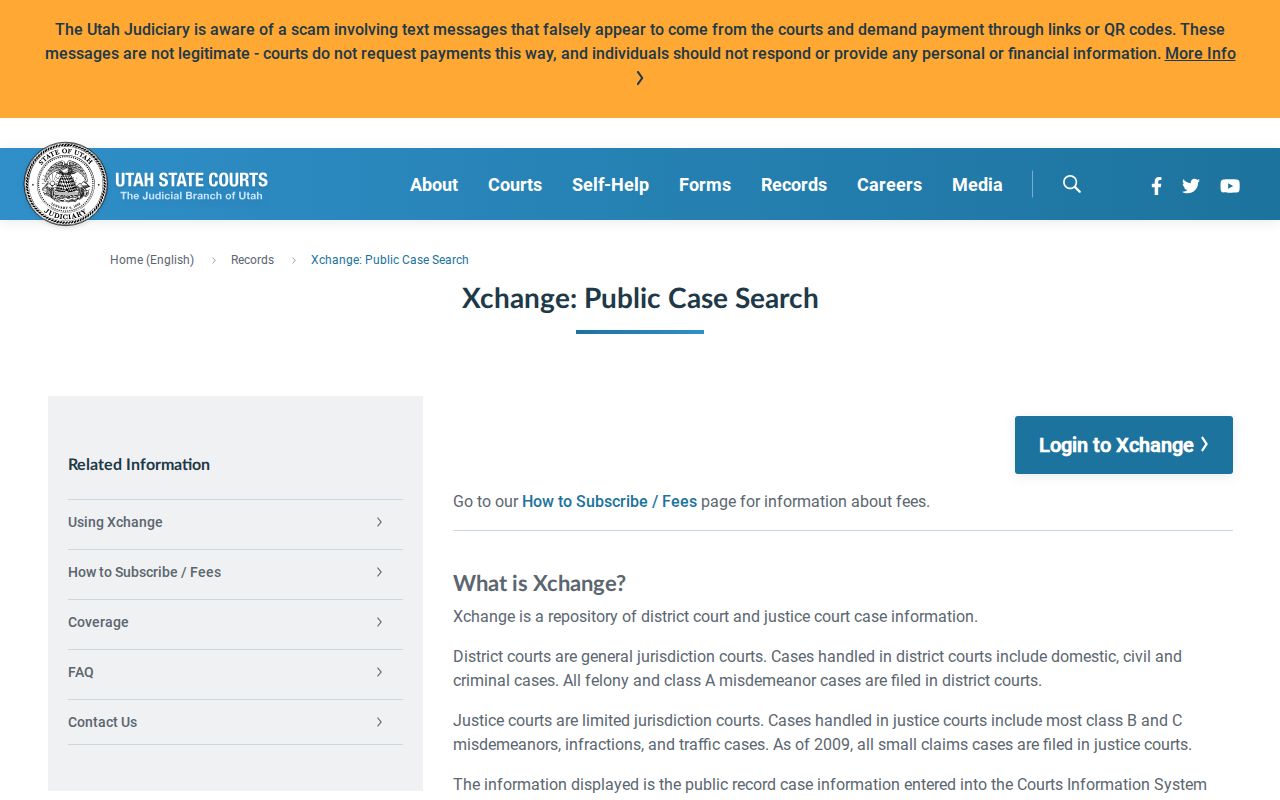
The screen is an index and case-history route. Certified proof still comes from the clerk that keeps the original case file.
Official Background Checks in Utah
Utah does not provide an unrestricted public BCI name search. A person reviewing their own Utah repository history uses the BCI Right of Access process. The application requires identity information, valid government photo identification, fingerprints, and a $20 fee. An in-person request at BCI does not require an appointment for this service. A mail request needs an official four-finger simultaneous impression and the completed payment and identification material.
BCI's UCCH record is not the same as Xchange. It groups fingerprint-supported Utah arrests with outcomes reported to the repository. Xchange instead presents court cases and docket events. For a nationwide review of your own record, the FBI Identity History Summary uses a separate fingerprint process and an $18 federal fee.
| Official product | Current fee | What it answers |
|---|---|---|
| BCI Right of Access | $20 | Your fingerprint-associated Utah criminal history |
| BCI record challenge | $20 | A request to review a claimed error or missing outcome |
| FBI Identity History Summary | $18 | Your national fingerprint history held by the FBI |
The BCI criminal-record page identifies the official Salt Lake County-area counter and current Right of Access requirements.
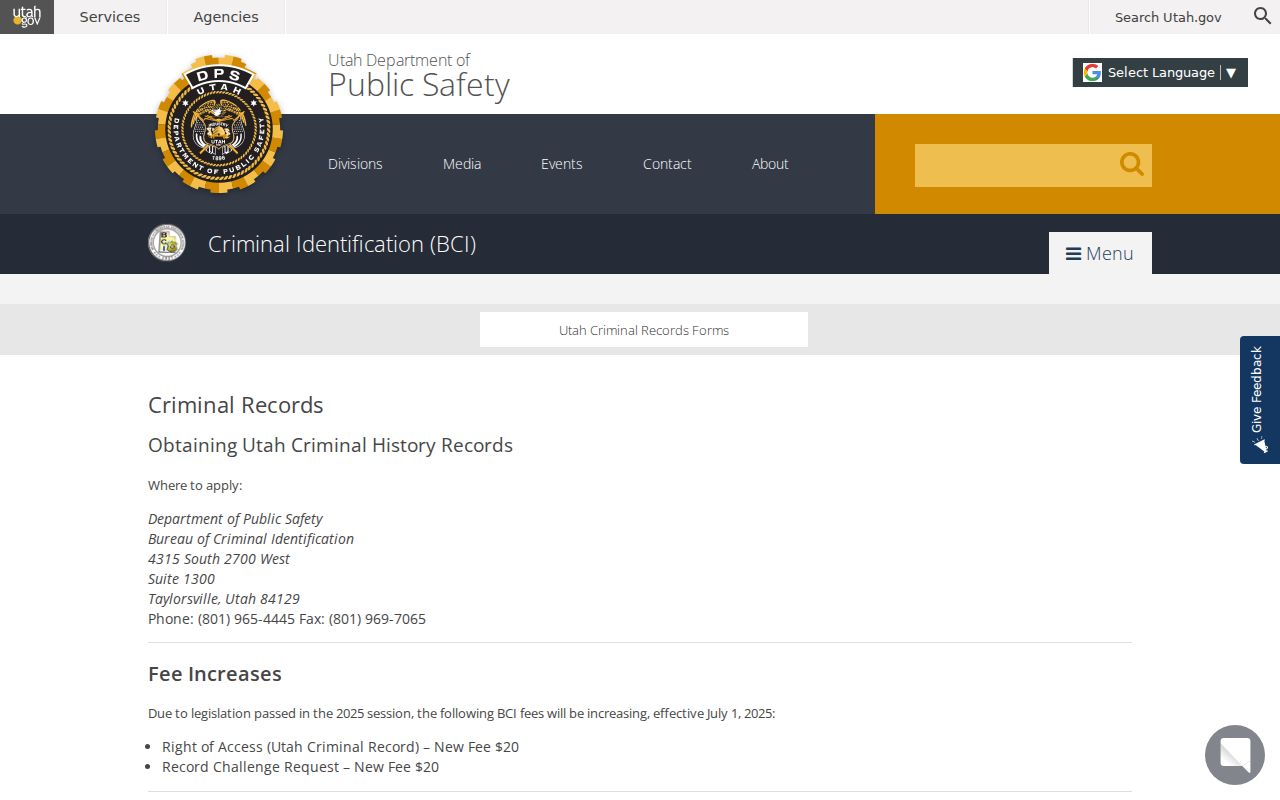
Use that secure government channel for fingerprints, identification, payment, and any challenge to your own Utah record.
Salt Lake County Criminal Court Desks
The Scott M. Matheson Courthouse is the main records building for Third District criminal cases filed in Salt Lake City. Its criminal desk handles the official court file, not the sheriff or prosecutor. The West Jordan Third District Courthouse serves district matters filed in the county's southern area. Salt Lake County Justice Court and the municipal justice courts keep their own lower-level files. A broad name search should account for those separate clerks.
Matheson Third District Court
450 South State Street, Salt Lake City, UT 84114
801-238-7321 criminal desk
West Jordan District Court
8080 South Redwood Road, West Jordan, UT 84088
801-233-9700
Salt Lake County Justice Court
2001 South State Street, Suite S4-300, Salt Lake City, UT 84190
385-468-8200
The official Matheson court listing includes a dated parking change for Salt Lake County court-record visitors.
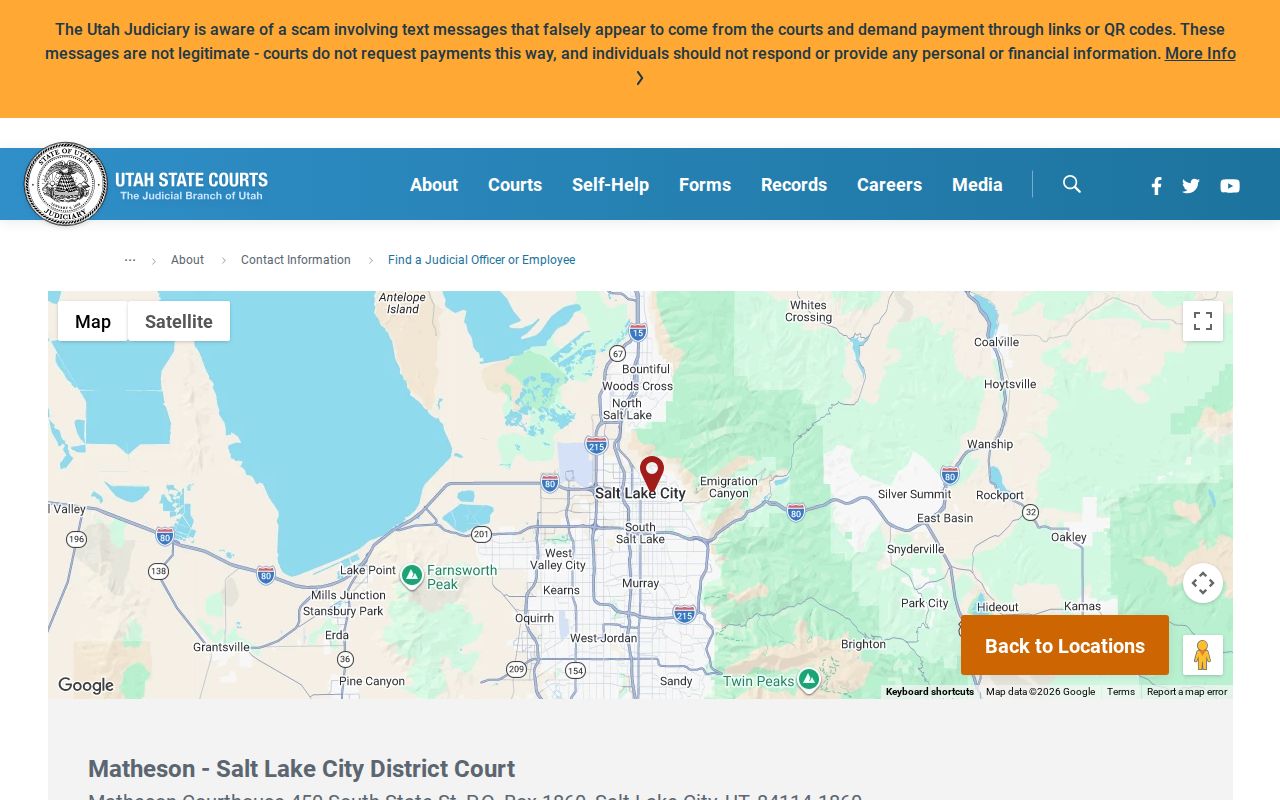
Since January 1, 2026, the courthouse garage has been closed to patrons without a valid disability placard or plate. Nearby public lots and transit are the stated alternatives.
Kinds of Criminal Records
A Salt Lake County criminal record is often a set of related documents, not one file. The agency report records the event. A booking file records jail intake. A prosecutor may then file different charges, and the clerk tracks the case through judgment. BCI links fingerprint-supported arrests to reported outcomes, while UDC maintains present state custody and supervision data.
- Incident and arrest reports: held by the sheriff, city police, UHP, transit police, campus police, or other creating agency.
- Booking and jail records: created when the Salt Lake County Sheriff accepts a person into county custody.
- Court case files: maintained by the District or Justice Court clerk after charges are filed.
- BCI history: a fingerprint-associated Utah repository record available to the subject through Right of Access.
- UDC and registry records: current state custody, supervision, and legally published registration information.
Police reports remain agency-specific across Salt Lake County. SLCPD, West Valley City Police, West Jordan Police, Unified Police, UHP, UTA Police, and campus agencies may each hold the narrative they created. A report may exist without an arrest, and a booking can occur before prosecutors decide whether to file. Utah offense class also directs the search: felonies and class A misdemeanors go to District Court, while class B and C misdemeanors and infractions generally go to the proper justice court. The Utah maximum terms range from up to 90 days for a class C misdemeanor, up to six months for class B, and up to 364 days for class A. Felony ranges depend on degree and the offense statute. Those labels describe charge levels, not the result of a particular case.
Salt Lake County Sheriff Record Requests
The Salt Lake County Sheriff's Office is the right custodian for sheriff-created incident, arrest, booking, jail, and administrative records. A request under the Government Records Access and Management Act should identify a record type, date range, location, incident or booking number, and the office involved. A narrow request is easier to route than a demand for everything connected to a name. The sheriff cannot supply a Salt Lake City Police report merely because the same person later entered county jail.
GRAMA generally calls for a response as soon as reasonably possible and within ten business days. The five-business-day path applies only when expedited access benefits the public rather than just the requester. Agencies may charge actual duplication and compilation costs under the statute, classify sensitive portions, deny with authority, or state that another entity holds the record. Historical warrant information may be requestable, but GRAMA is not a real-time warrant clearance tool.
Note: A jail facility is not automatically the correct records counter, so confirm the sheriff's current submission route before traveling.
Salt Lake County Criminal Records: What They Contain
Read a record by event cycle. Begin with identifiers and aliases, then compare the arresting agency and date, booked charges, filed charges, disposition, sentence, and current custody or supervision. Differences can be real. An arrest charge may change during prosecutor screening, and a missing BCI disposition may reflect delayed reporting or an identity match problem rather than an open case.
| Name and identifiers | Legal and former names, birth information, and record numbers used to separate people with similar names. |
|---|---|
| Arrest and booking | Agency, date, intake number, custody site, booked allegations, holds, bond, and release status. |
| Court charges | The allegations filed by a prosecutor, their Utah statutes, and later amended or dismissed counts. |
| Disposition | The court outcome, such as dismissal, acquittal, plea, or judgment. |
| Sentence | Custody, probation, fines, restitution, and other terms entered by the court. |
| Current status | County custody, state incarceration, probation, parole, or a registry duty when publicly available. |
Salt Lake County Custody Record Paths
Salt Lake County operates the Metro and Oxbow jails, but their records answer county custody questions only. The sheriff's prisoner-information route can show whether a person is presently held, booking data, charges entered at intake, and release or bond information. Entries can change as a person transfers or leaves custody. Absence from a live roster is not proof that no arrest occurred.
Use UDC Offender Search for people incarcerated by Utah or under UDC probation or parole. It expressly excludes unsentenced people awaiting trial in a county jail. Federal custody follows the Bureau of Prisons route. The systems answer different questions even when the physical facilities are all within Salt Lake County.
Arresting agency → county booking → prosecutor screening → District or Justice Court → BCI outcome reporting → UDC custody or supervision when imposed.
Utah Public Access Laws
GRAMA starts from a right of access but sorts government records as public, private, controlled, protected, or exempt under another law. Court records also follow judicial access rules. BCI dissemination has separate limits, so a GRAMA request cannot turn the fingerprint repository into a public name-search product. Juvenile matters, sealed or expunged cases, victim information, medical data, protected investigative material, and security details may be withheld.
Key Utah laws:
Utah Code Title 63G, Chapter 2 defines GRAMA access, fees, response rules, classifications, and appeals.
Utah Code Title 53, Chapter 10 governs BCI functions and access to criminal-history information.
Utah Code Title 77, Chapter 40a controls expungement and restrictions on qualifying records.
Utah Code Title 53, Chapter 29 governs Utah offender registration and public registry duties.
Salt Lake County Warrant Verification
No verified public countywide sheriff name search for active warrants was found in the research. Xchange may show warrant or failure-to-appear activity in a related docket, but the public history is not a guarantee of current status. Call the issuing clerk, using Third District Court for felony and class A matters and the correct county or municipal justice court for lower-level and traffic cases.
Confirm through official numbers where arrest risk exists. A recalled warrant can remain in a downstream system during transmission, while a missing online entry cannot prove that no warrant exists. Keep the court's proof after a recall or resolution and ask when the order will reach law enforcement. Search warrants, juvenile warrants, and sensitive unserved process may be sealed.
Use a verified court number: Do not send money to a caller claiming to clear a warrant. The issuing court controls recall, appearance, bond, and compliance steps.
Restricted, Sealed & Expunged Records
Utah defines expungement as sealing or otherwise restricting access to an arrest, investigation, detention, or conviction record. It does not erase independent news or private copies. Petition-based relief starts with a full history review and a BCI certificate-of-eligibility application. The initial BCI application costs $65 and requires fingerprints and identification. BCI says processing can take one to two months and cannot be expedited.
If eligible, a person buys the required certificate, files it with the proper court within 180 days, completes notice or hearing steps, and distributes certified orders as directed. BCI lists $65 for each conviction, plea-in-abeyance, or special certificate, while Utah Courts lists a $150 district filing fee. The official expungement FAQ explains processing and fees, while the BCI application index separates adult, juvenile, vacatur, pardoned, and registry-removal forms. Eligibility depends on the whole record, waiting periods, pending matters, supervision, and offense exclusions.
The Utah BCI expungement page reflects the current process and the 2026 automatic-record route.
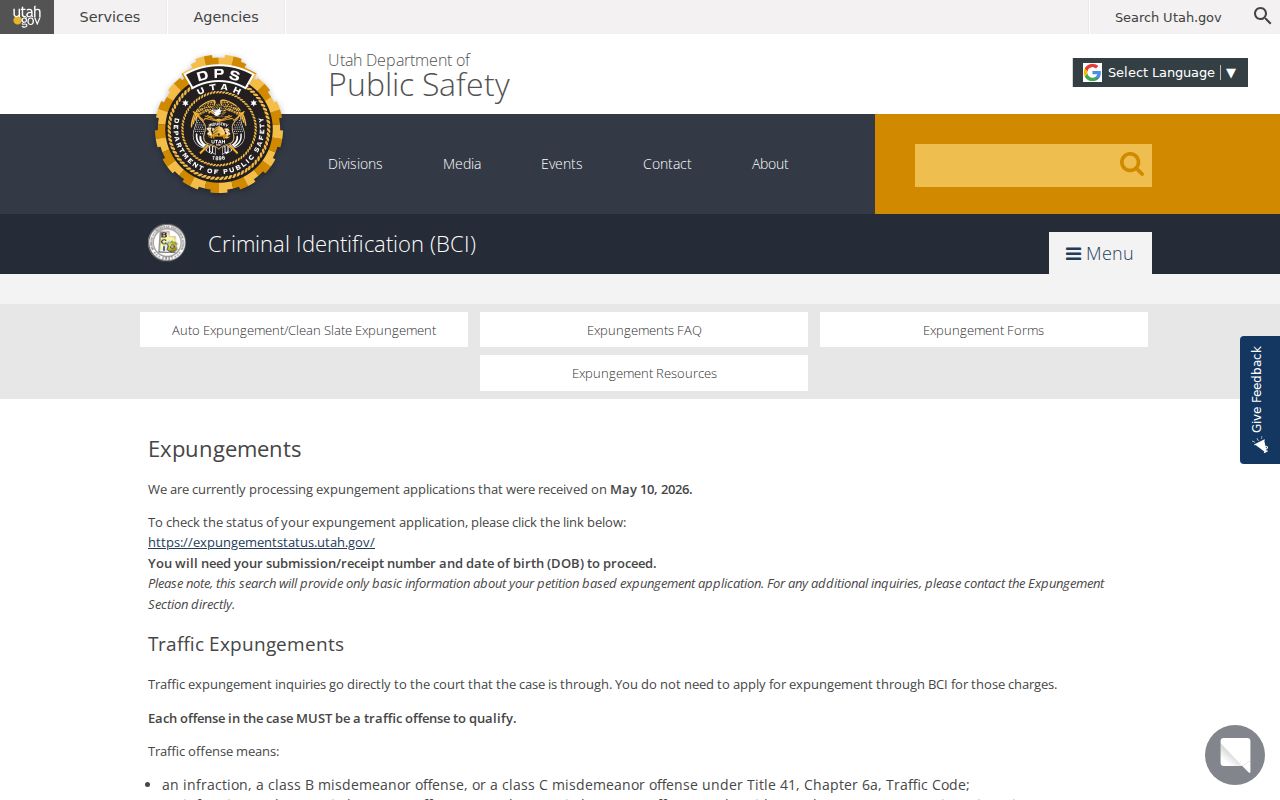
As of January 1, 2026, courts identify eligible automatic cases. The expired temporary request workflow should not be used; check the BCI Clean Slate page for the present automatic route.
Salt Lake County Charge Screening Records
The Salt Lake County District Attorney's screening decision explains why jail charges and filed counts may differ. Police and sheriff reports record the initial allegation. Prosecutors decide whether a qualifying county case should be filed and under which statutes. The clerk's docket then becomes the official source for filed charges and their outcome. A District Attorney file can contain protected work product, victim material, and active-case information that is not part of the public court record.
The office is at 35 East 500 South in Salt Lake City and uses its own GRAMA channel for releasable records. It is not a substitute for the court clerk. Likewise, the Salt Lake Legal Defender Association's client file is confidential even when an attorney-of-record entry appears on a public docket.
The official District Attorney page identifies the prosecution office and its county role.
For the final charge, plea, disposition, and sentence, follow the case number back to the responsible District or Justice Court clerk.
Salt Lake County Supervision Records
Adult felony probation and parole are state-run through UDC Adult Probation and Parole. Region 3 serves Salt Lake, Summit, and Tooele counties from 36 West Fremont Avenue in Salt Lake City. Probation is a court-ordered community sentence. Parole is release from prison under the Utah Board of Pardons and Parole, with community supervision by AP&P.
Check the court docket for the sentence and later probation events, then use UDC Offender Search for a current public supervision status. Board hearing or release decisions can add another record layer. A probation violation returns to the court, while parole action follows the Board and UDC process. Technical violations and new charges are not interchangeable. A public locator may show legal status, committing court, case number, sentence length, and key Board dates, but a blank field should not be treated as proof that no condition or protected detail exists.
- Probation
- A court-ordered period of supervision in the community, often with conditions recorded in the case file.
- Parole
- Community release from prison decided by the Board and supervised through UDC.
- Disposition
- The court's outcome for a charge, which may include dismissal, acquittal, plea, or conviction.
- Booking
- The county jail intake event, which does not establish guilt or prove that charges were filed.
City-by-City Criminal Records in Salt Lake County
City police agencies keep their own reports, and city justice courts retain lower-level cases within their jurisdiction. Salt Lake City, West Valley City, and West Jordan are the county's three largest incorporated cities in the research ranking. Each local record check starts with the city office that created the report, then follows any booking to the county sheriff and filed case to the proper court.
Salt Lake City Record Check
SLCPD GRAMA, its Records Service Desk, and Salt Lake City Justice Court.
West Valley City Record Check
West Valley City Police records and the city's own Justice Court.
West Jordan Record Check
West Jordan Police request portals and West Jordan Justice Court files.