
Salt Lake City Criminal History Checks
A city search has several official starting points. Choose one by record type and date. The Salt Lake City Police Department has its own reports. The John L. Baxter Courthouse has the city justice docket. Salt Lake County Sheriff records show a person booked into county custody, while Utah Courts Xchange covers filed public cases across court lines. BCI Right of Access is reserved for a person seeking their own fingerprint-based Utah history.
- Ask SLCPD for the incident or arrest report when city officers created the record.
- Use the Salt Lake City Justice Court calendar, clerk, MyCase, or Xchange for a city charge.
- Check Salt Lake County prisoner information when an arrest led to a county booking.
- Move to Third District Court when the filed matter is a felony or class A misdemeanor.
- Use BCI Right of Access only to review your own fingerprint-linked Utah repository record.
Keep the case number, police report number, event date, location, and exact name spelling close at hand. Each can resolve a common-name match or help a clerk find an older record.
Salt Lake City Police Record Requests
SLCPD accepts requests through its official GRAMA page and the city's JustFOIA portal. The requester describes the record, event date and location, case number if known, involved names, delivery details, and the basis for any identity-dependent access. Records can include chronological or service-call logs, initial-contact reports, photographs, and traffic-accident reports. An open investigation or protected victim material may be withheld or redacted.
| Salt Lake City item | Current fee |
|---|---|
| Report through 50 pages | $15 |
| Report pages after 50 | $0.25 per page |
| Photocopies | $0.10 per page |
| Photographs | $20 for the first 100, then $10 for each next 100 |
| Body-camera data | $34 per 5 GB |
| Body-camera redaction | $47 per hour, billed in 15-minute units |
| Staff preparation after first 15 minutes | $20 per hour |
The successful manifest image from the SLCPD GRAMA source records the city request channel.
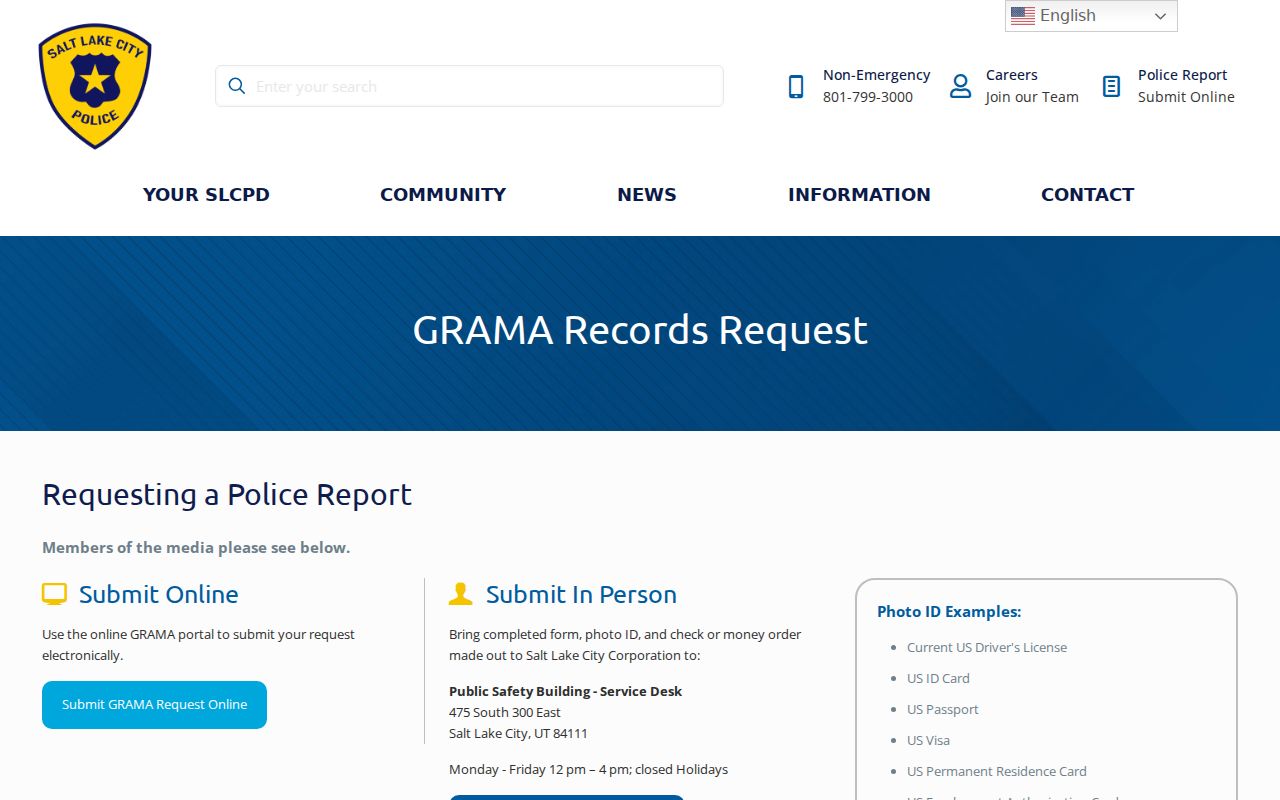
The form is the right route for city police material that does not appear in a public court or jail search.
Records at the Salt Lake City Police Department
The SLCPD Records Service Desk is inside the Public Safety Building at 475 South 300 East, Salt Lake City, UT 84111. Its mailing address is P.O. Box 145497, Salt Lake City, UT 84114. Records staff can be reached at 801-799-3101, Monday through Friday from noon to 4:00 p.m., excluding holidays. General police information uses 801-799-3100, non-emergency dispatch uses 801-799-3000, and Evidence/Property uses 801-799-3041.
An in-person Salt Lake City request needs the completed form, acceptable photo identification, and a check or money order payable to Salt Lake City Corporation. The report belongs to SLCPD when its officers created it. A county jail entry does not replace the police narrative, and a Utah court case does not include every investigative attachment. Ask for a narrow set of records to reduce search and review time.
SLCPD Records Service Desk
475 South 300 East
Salt Lake City, UT 84111
801-799-3101
Monday-Friday, noon-4:00 p.m.
Closed on holidays
The manifest's SLCPD contact capture shows the service-desk and LiveScan source used for these details.
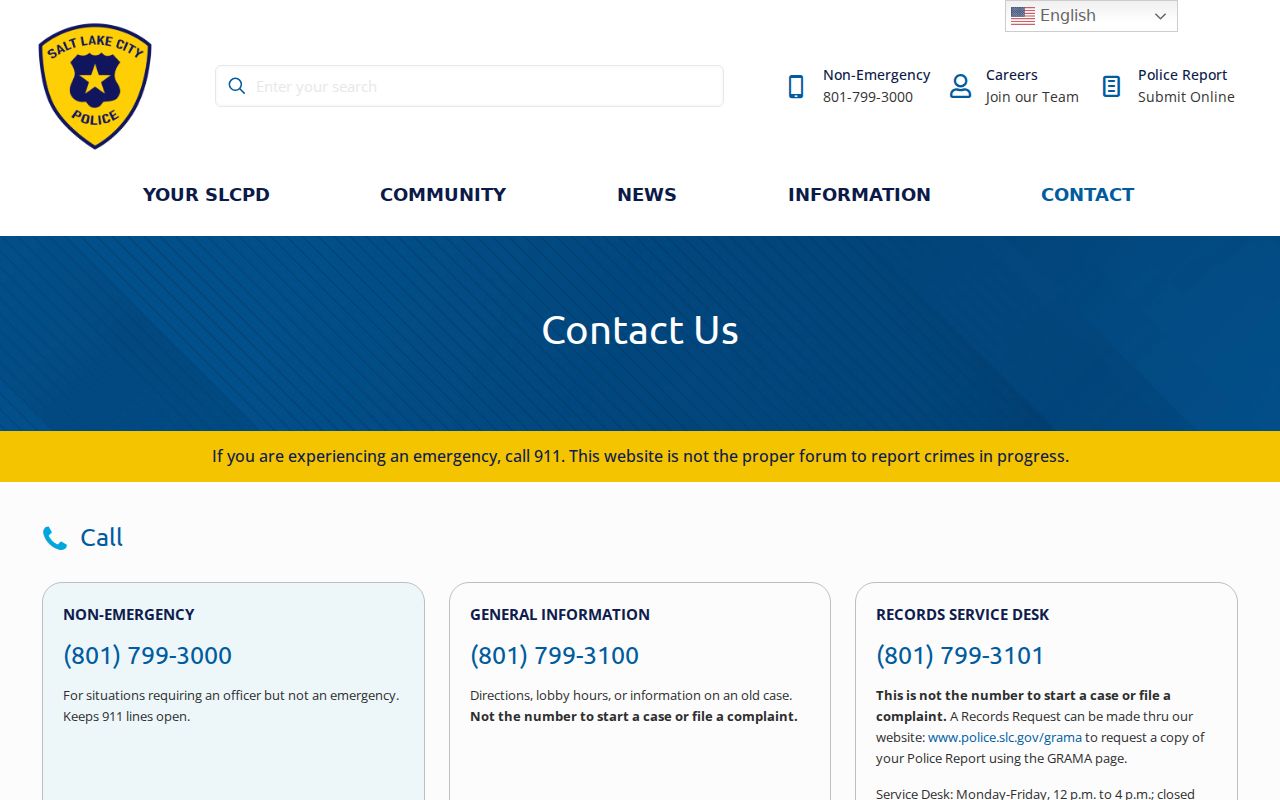
This desk combines local report access and limited fingerprint service, but each service follows its own form and identity rules.
Salt Lake City Record Identification Rules
SLCPD lists a current United States driver license or identification card, passport, visa, permanent-resident card, concealed-weapon permit, military ID, and certain other current federal photo documents as acceptable examples. A Utah Driver Privilege Card alone does not meet the city's office-identification rule. The city instructs a holder to add two current documents from different approved categories.
Those supporting groups include legal records, qualifying utility proof other than a cell-phone bill, a photo membership, work or school credential, and bank material. Bring only what the official channel requests. Identity rules matter because a victim or arrestee may have a right to material that is not available to a general public requester. They do not turn a protected investigation into a public record.
Note: Confirm accepted documents before visiting, since an expired card or one unsupported privilege card can delay a Salt Lake City request.
Booking and Arrest Records in Salt Lake City
Salt Lake City has no identified independent city jail. SLCPD may create the arrest report, then a regional booking appears through the Salt Lake County Sheriff's prisoner-information channel. That split explains why one event can require two requests. Police records cover the officer's contact, legal basis, reported offenses, and investigative details. County corrections records cover intake, custody, listed booking charges, holds, bond or release, and facility status.
A recent arrest may reach the jail before a prosecutor files a court case. A citation may never create a county booking. Search the county prisoner path for current or recent custody, then follow filed charges through the correct court. The broader Salt Lake County arrest search explains county jail and agency fallbacks without turning the city page into a county-wide account.
Do not treat a Salt Lake City arrest as proof of guilt. Booking charges can change after screening, and the later court result may be dismissal, acquittal, plea, or conviction.
Salt Lake City Incident Record Stages
Salt Lake City offers free online reporting for certain non-emergencies inside city jurisdiction and off a state highway. A current email address is needed. Eligible categories include certain harassment, theft or shoplifting, catalytic-converter or bicycle theft, fraud, identity theft, no-injury hit-and-run, lost property, and supplements. Attachments can be included. This tool creates a report for review. It is not an arrest log.
The submission first receives a temporary number. SLCPD reviews the report, and an approved submission receives an official case number and summary. Until that review occurs, the temporary number should not be mistaken for a filed court case or a final police record. An online incident report also does not prove that officers identified or arrested a suspect.
Record timeline: online submission › temporary number › SLCPD review › approved case number and summary.
The Salt Lake City Municipal Court File
The local tribunal is the Salt Lake City Justice Court at the John L. Baxter Courthouse, 333 South 200 East. Its mailing address is P.O. Box 145499, Salt Lake City, UT 84114-5499. The clerk's number is 801-535-6300, and the office is open Monday through Friday from 8:00 a.m. to 5:00 p.m. Criminal and traffic phone service runs 8:30 a.m. to noon and 1:00 to 4:00 p.m.
| Court Name | Salt Lake City Justice Court at the John L. Baxter Courthouse. |
|---|---|
| Cases Heard | Alleged class B and C misdemeanors, infractions, city offenses, and qualifying traffic matters. |
| Public Search | Daily calendars, Xchange, clerk phone or counter, and requests for older or unavailable records. |
| Party Access | MyCase where the case and party qualify. |
| Docket Content | Filed charges, events, hearings, pleas, orders, disposition, sentence, and accounting when public. |
| Certified Records | Request them from the clerk rather than treating an online summary as certified proof. |
The assigned Salt Lake City Justice Court capture documents the court's official access page.
This is the key city clerk source, while felony and class A filings move to Utah's Third District Court.
Salt Lake City Court Record Channels
The court publishes daily calendars that can be selected up to 30 days out. Browser find can locate a name or case number on the displayed calendar. A party can use MyCase for an eligible case. Public nonparties use Utah Courts Xchange, while the clerk handles certified copies, older files, and matters not available through the online tools.
Each channel answers a different Salt Lake City question. The calendar shows scheduled court activity, not a full history. MyCase is tied to the participant's own access. Xchange supplies public case summaries and available documents, but sealed, expunged, juvenile, and other nonpublic matters are omitted. The clerk remains the record keeper. For a deeper account of district and justice records, use the Salt Lake County court case lookup.
The court also operates Homeless Outreach Court, a named local program. A program setting may change how a case is addressed, but the official docket and clerk still control the public court record.
How Salt Lake City Records Reach the County
An SLCPD contact can create an incident or arrest report even when no charge is filed. If the person is booked, Salt Lake County corrections creates a separate custody event. The city prosecutor and justice court handle qualifying lower-level city matters. Felonies and class A misdemeanors proceed in Third District Court. Court outcomes can then be reported to the Utah Department of Public Safety, Bureau of Criminal Identification.
Record flow: Salt Lake City Police Department › Salt Lake County booking or Utah court filing › Utah Department of Public Safety, Bureau of Criminal Identification.
Timing and identity matching can make the pieces disagree. A booking charge is not always the filed count. A missing BCI disposition can reflect a reporting gap rather than a pending case. For Salt Lake City activity, verify the source report and court result before using a state history to describe the event.
Salt Lake City Court Record Delays
A DUI citation may take up to 30 days to reach the city prosecutor and court. That delay can explain why a recent citation is absent from a Salt Lake City court search. It does not cancel the obligation on the citation. Keep the citation and check the official clerk channel rather than creating a second identity or guessing a case number.
Most ordinary first appearances can be scheduled through the court's online or WebEx process. DUI and domestic-violence matters cannot use self-calendar. The court schedules those matters for the fourteenth business day after the alleged offense. This local rule is a good example of why an empty calendar search and an official instruction can coexist for a short time.
Note: A city court delay does not prove dismissal, and the citation's official instructions continue to govern while the filing is processed.
Salt Lake City Record Access Rules
Utah's Government Records Access and Management Act, or GRAMA, applies to executive-agency records such as releasable SLCPD material. It classifies records as public, private, controlled, protected, or exempt under another law. Courts use judiciary access rules as well, so a police GRAMA request is not the way to obtain every court file. Ask the agency to identify its classification and authority when it withholds a record.
Key statutes and rules:
Utah Code Title 63G, Chapter 2 defines GRAMA access, fees, request steps, classifications, and appeals.
Utah Code Title 53, Chapter 10 governs BCI functions and limits access to state criminal-history information.
Utah judiciary access rules control public court records and Xchange, separate from a city police request.
Common limits include active investigative material, juvenile information, sealed or expunged cases, victim and witness safety, medical or mental-health details, security procedures, and personal identifiers. Narrow Salt Lake City requests by record type and date. A precise request is easier to classify and search.
Salt Lake City Crime Record Limits
SLCPD's official dashboard can be viewed citywide or by council district, community council, and ZIP across the preceding 60 months. Its counts are preliminary incident and NIBRS summaries. They are not counts of victims, suspects, arrestees, or convictions. The public crime map uses a rolling six-month window, adds a month on the fourth, and moves incidents to nearby intersections to reduce location precision.
Use those tools to understand local patterns, not to check the outcome of one Salt Lake City case. A map point is not a person, and a dashboard total is not a docket. Follow one event through the police report, county booking path, and correct court. That source-by-source method preserves the difference between a call for service, reported incident, arrest, charge, and conviction.